|
Ian Whitcomb,
an English undergraduate at Trinity College Dublin, had been
involved in the local music scene ever since he arrived there in
1961. First he joined the TCD jazz band on piano, and later he
formed a quasi-R&B band called "Warren
Whitcomb & His Bluesmen"--whose only
appearance was at the Trinity Jazz Band Ball at the Shelbourne Hotel
in St. Stephen's Green in the winter of 1962, and a cold one it was
indeed. Ian was influenced very much not only by recordings of
genuine black American electric blues by the likes of Muddy Waters
but also by the success of British blues groups such as
Alexis Korner and
Cyril Davies. He
was very serious about his blues and wanted to start a proper R&B
group complete with electric guitars.
Through local
jazz outfits he had met Barry Richardson, another English
undergraduate, and he and Barry discovered they had a mutual
interest in R&B. Together they schemed to start their own outfit.
Barry, a bass player and reedman, awas currently playing with a
showband called The Crickets and so the first assembly
consisted of members of that band since they owned the requisite
electric guitars and amps. The agreement was that they could play
with us if they brought all the equipment with them.
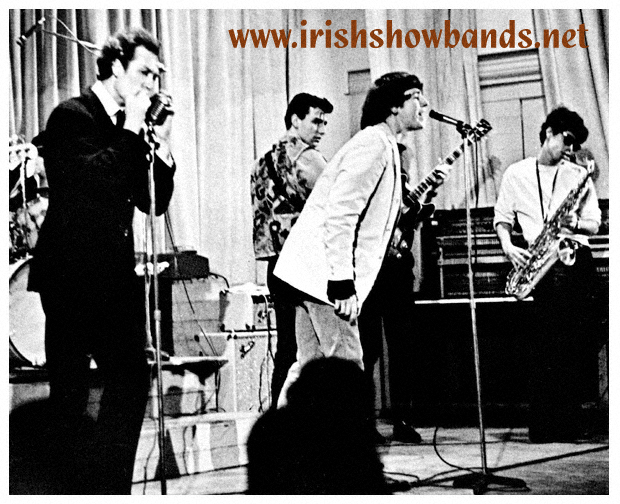
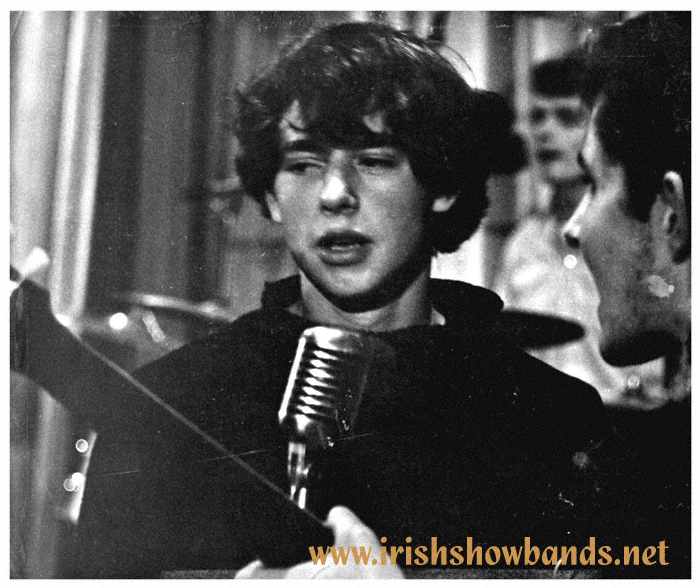
Ian played piano
and did most of the frenetic singing. The rest of the band consisted
of two guitars, fender bass, drums, and Barry on saxophone. Ian
dreamed up a name Bluesville Mfg., Inc., inspired by
Alexis Korner's Blues Incorporated
which was operating over on the mainland at the Ealing Club.
Bluesville was soon hard at work learning numbers like "I'm Your
Hoochie Coochie Man" and "Built For Comfort". Ian had been an
enthusiast for gutsy boogie piano and hard blues since the late
Fifties, but bear in mind that a little earlier he'd been the first
boy at his English boarding school to proudly display Bill Haley's
first LP, "Rock Around The Clock" and to champion Elvis as well as
Danny & The Juniors. So he was there defending original rock & roll
when it was looked down on by his peers.
One of the first
Bluesville appearances was at St. Anthony's Hall on the
Quays. This was a lunchtime show and Ian was several sheets to the
wind on ale and spirits when he came on stage. The result was that
he fell all over the loudspeakers. He was surprised to hear the
girls screaming in ecstasy and he realized he had a certain sex
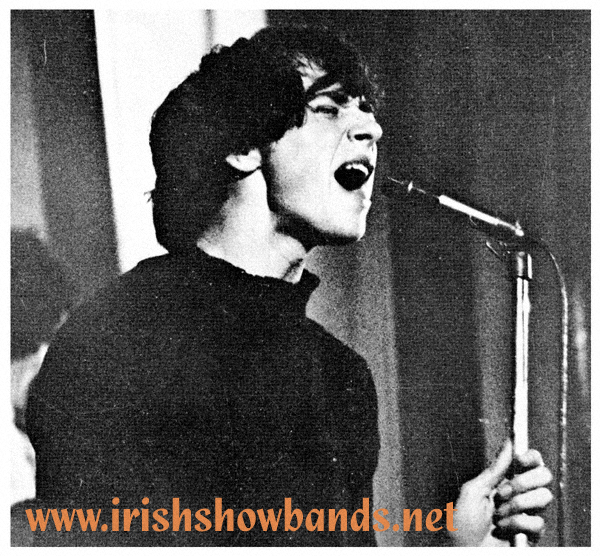
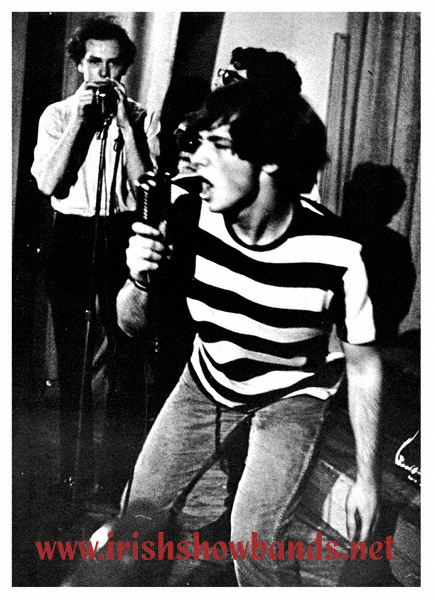
appeal. He capitalized on this, flinging himself around the stage
and hollering and fondling the mike at subsequent gigs--which, when
not at religious centres were invariably at tennis clubs. The local
"gurriers" took to calling the group, "De Bluesvilles",
slotting them into the long line of Irish showbands.
But the band was
a reaction to what was seen by the In Crowd as the enervating
old-fashioned music of the showbands. What was happening was the
Irish equivalent to the beat group mania currently infecting
Britain. The Rolling Stones
were becoming popular and as Ian bore a passing resemblance to Mick
Jagger he was frequently stopped in the street by punters who
enquired, "Are yer Mick Jaggers?". Ian took this as a compliment.
There was an even greater compliment in a note he received which
read, " I would like to have sexual intercoarse(sic) with you at
your earliest convenience, Yours, Moira". This was framed and hung
on a wall in his TCD rooms to the amusement of his fellow history
students.
By this time
Bluesville had taken on a new personnel due to Barry
Richardson's having joined another showband, this one called "The
Alpine Seven", named after the manager's car. This was the band,
largely, that was to make the historic recording. TCD students,
hitherto haters of what they saw as commercial crap, now became
interested in Bluesville. Many of them attended a memorable
show at Mount Merrion, another religious centre, where Ian, in the
middle of "Bony Moronie", fell through some rotten floorboards.
Again, the girls screamed in intense pleasure. It was at this
concert that the band was offered a stint at the Star Club in
Hamburg by one Dermot Hurley.
Somehow it never materialised. It was also at this cconcert that the
band first played Ian's arrangement of an old folk song he'd learned
during the skiffle craze era called "This Sporting Life". The
idea was to make a song that capitalized on the sound of the
Animals' "House Of The Rising Sun".
At this stage Ian
had secured a recording contract with a Seattle label, Jerden
records. He had done this while on vacation there in the summer of
1964. The label owner, Jerry Dennon enjoying great success
due to "Louie Louie" by the Kingsmen which he had produced.
Bluesville's first release was an instrumental called "Soho", which
consisted of Ian and Barry plus a bass drum, but the other side was
a Bluesville recording of "Bony Moronie" made in a Merrion
Square basement earlier in 1964. Ian was determined to make a hit
song. This meant abandoning the strict blues content, the slavish
imitation of the African-American music that had been the driving
force begin the band. But Ian knew it was pointless to try to copy
black music and that his sex appeal and the burgeoning beat scene
could catapult him and the band into the mainstream. But he knew
this could only be done by having a hit record. And this is what he
now devoted his time to. "Sporting Life" was just one of his
efforts. He also wrote a lot of other songs such as "Too Many
Cars On The Road" within the hallowed walls of the TCD Library.
The band
continued to go from strength to strength in Dublin--there was
nothing else like it in the Republic. The sole rival was Them
in Belfast. Bluesville played most of the tough venues in
Dublin--sometimes fights broke out and blood mingled with the stout.
Ian can remember leaping from the stage to tackle a ruffian who'd
insulted him. The best-run place was "Sound City" down at
Burgh Quay where the management really understood how to present
beat music. The chief mover there was a smart young entrepreneur
called Tony Boland who went on to work with Sir Bob Geldof.
In the winter
1964 Ian took the band, minus Barry Richardson who had
graduated and was back in England working, into the Eamonn Andrews
studio in Henry Street. to perfect "This Sporting Life". He
had tried an earlier version in Peter Sellwood's Merrion Square
basement studio (where Bluesville's first recordings, including
"Bony Moronie" had been made), but it didn't cut the mustard. The
Eamonn Andrews version, which had the addition of Bill
Somerville-Large on organ, was on the right track. But Ian
wasn't satisfied and during the Christmas vacation he few to Seattle
and there added a beefier organ played by one of the local big
beatsmen, Gerry Roslie. This was the version that was
released on the Jerden label in January, 1965 and it soon made the
Seattle top ten. Sensing a new sensation Tower records, a newly
formed subsidiary of Capitol Records, leased the master and with the
giant's push the record dented the Billboard Top Hundred. "This
Sporting Life" garnered a lot of attention because of its odd
sound--a combination of swirling electric guitars with organ and
piano--a sound known in black gospel churches but hitherto unheard
in the world of commercial pop. This was not lost on Tom Wilson,
the black producer of Bob Dylan records: when he later cut
"Like A Rolling Stone" he used a similar combination. He told an
English journalist, Virginia Ironside, that Bluesville's record was
what jogged him back to his gospel roots.
On the strength
of the record's American success Jerry Dennon flew to Dublin
to oversee an album session for Bluesville. At the very end
of the session the band launched into a shuffle-beat thing that had
had the girls excited in the clubs. Ian used a phrase he'd learned
in America from a Seattle girl who'd been stimulated by his accent:
"You're turning me on", she'd said. He inserted some orgasmic
panting at the end of each chorus and made up the rest of the words
as the band played on. It was one of those improvised affairs at the
end of a session when there's a few minutes to fill in. But this was
the track that was released as the follow-up to "Sporting Life". At
first it had no title, then it became "The Turn On Song" and
finally "You Turn Me On". There was no stopping this
monster--a record that Ian was not proud of--and by July, 1965 it
reached Number 8 in the Billboard chart. Ian went to America without
the band, for reasons of economy and the fact that the band seemed
reluctant to leave Dublin. In America he toyed with the Rolling
Stones, The Beach Boys, Sam The Sham and The Pharoahs, the Kinks,
etc. But he always used pick up bands. He missed the tight and
special sound of Bluesville with its locked-in twin guitars of
Mick Molloy and Deke O'Brien, and especially the unique
sound of Ian McGarry's drumming which utilized the bass drum
in patterns hirtherto not heard on pop records. Soon he was a bona
fide teen heart throb. However, he left a big tour (he was replaced
by Tom Jones) in order to return to TCD and sit for his finals in
modern history. He got a second class degree. The band had been
performing in his absense and this caused a little bit of friction
since Ian disliked seeing another member taking over all the moves
of his stage act. He rewarded the culprit with an onstage blow to
the head with his rolled-up copy of "Billboard".
After this Ian
returned to America to pursue his teen idol career and Bluesville
gradually petered out. They reunited in 1966 for the Trinity College
Ball but after that it was no more. But Bluesville have a
historic place in the history of Irish rock: not only did they
inspire countless locals to get into hard rock but they were also
the first Irish-based band to get into the American Top Ten.
For the record
the basic Bluesville band that recorded both "Sporting
Life" and "You Turn Me On", as well as the tracks that
made up the first LP were as follows: Ian Whitcomb, piano &
vocals; Mick Molloy, lead guitar;
Deke O'Brien, rhythm guitar; Gerry Ryan,
bass guitar (Bryan Lynch of The Greenbeats played on
"This Sporting Life"); Ian McGarry, drums. On certain tracks
Barry Richardson and Peter Adler played saxophones. In
the early 1980s Big Beat records, a subsidiary of Ace (founded by
Dublin's own Ted Carroll, who used to book Bluesville at the
Rathmines Tennis Club), released an EP called "Bluesville". For more
detailed and colorful information on Bluesville see Ian Whitcomb's
books, "Rock Odyssey", "Whole Lotta Shakin'" and
"After The Ball". All these books are
available at various times on eBay.
courtesy of Ian Whitcomb
2005 (Ian's website). |